Loading
How the show is played
Instructions
Ten Directors compete to build ten completely different horror movies through a live 16-selection draft. Your goal is to build one original horror movie by completing all 16 storytelling Tiers. Your selections determine the characters, Killer, Main Role, Opening Victim, Sidekick function, Genre, Location, Weapon, Event, Ending, Era, Budget, and the other elements that ultimately define your film. You are not writing a screenplay during the draft: you are making creative and strategic choices that become the foundation of one.
Every choice matters because all 16 selections must eventually work together as a single movie. Some Tiers give you additional creative decisions beyond the initial selection. Others introduce risk because another Director can remove something you wanted before your next turn. Budget creates another kind of risk: you can see the financing still available, but you cannot choose how much the Financiers give you. You will not control everything, and that uncertainty is part of the game.
Director Name and Studio Name
Your Director Name and Studio Name are two different identities. Your Director Name is established when you sign up for HFFD and identifies you as the Director playing the game. Your Studio Name is the fictional movie studio you create for the draft, and it represents you on the live draft board. It does not replace your Director Name. If your completed movie receives a Feature Presentation, both become part of the movie’s official attribution on the Theatrical Poster.
How the draft works
On your turn, you have 60 seconds to make one selection. You may draft from any Tier you have not already completed: the Tier numbers do not decide the order. You might draft Location first because there is one you do not want to lose, take Main Role early because that character gives you an idea, take Sidekick early because a particular narrative function matters to you, approach the Financiers early while every Budget is still available, or wait on Weapon because several choices still work for you.
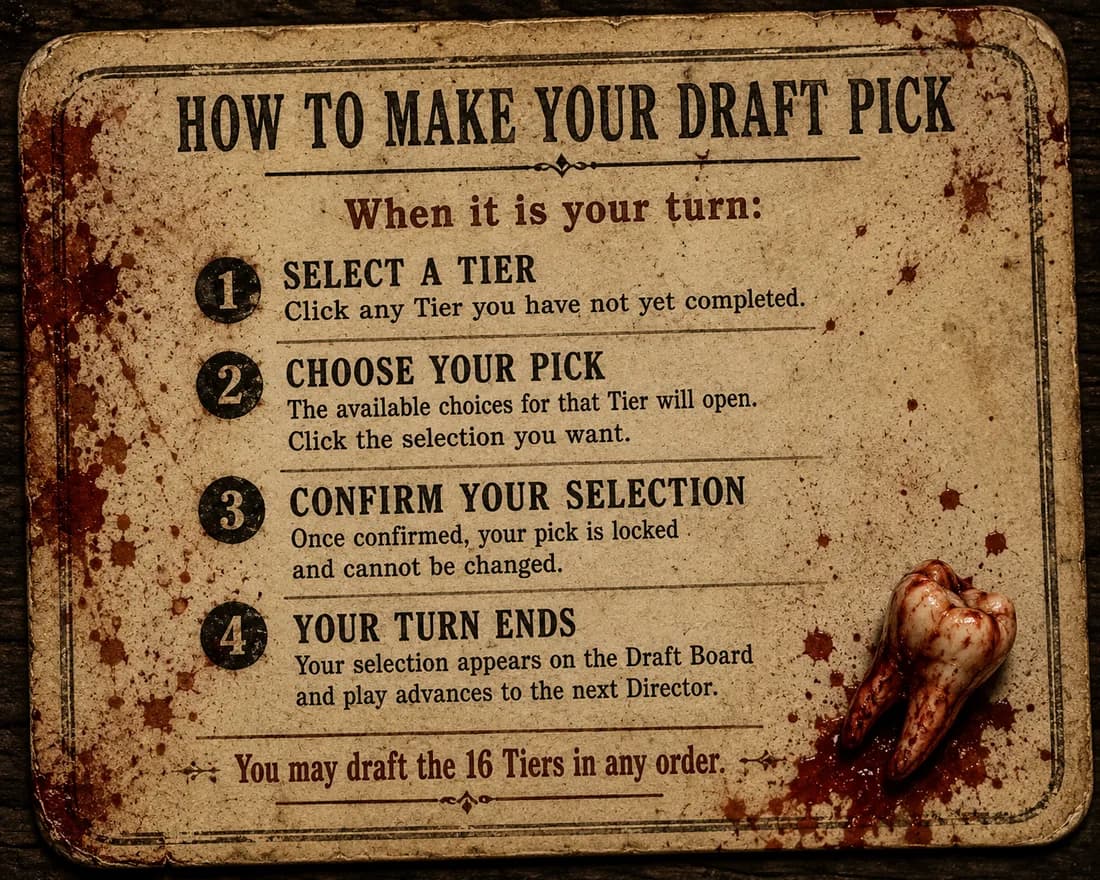
A selection takes two taps: one to choose it, one to confirm. Once confirmed, it becomes part of your movie and is locked. You cannot exchange it later because another option works better with what came after. When an option is exclusive and another Director takes it first, it is gone: adjust your strategy and choose from what remains.
Some Tiers ask one more thing of you. Main Role comes with a Character Profile: once you have drafted the archetype, you decide who that person actually is. It is part of your Main Role selection, it does not consume another pick, and the turn clock does not run on it. Budget works differently from an ordinary creative Tier: you select when to approach the Financiers, they decide how much money your movie receives from the amounts still available, and the result is revealed immediately.
The draft continues until every Director has filled all 16 positions. The challenge is not collecting 16 choices you like. The challenge is building a movie while the board changes around you.
Watch the entire board
Every Director sees the complete live board for all ten Studios: which Tiers the others are drafting, which choices they have made, how their movies take shape. Another Director may take the option you were planning to draft. Several Directors avoiding a Tier may mean you can safely wait. A group of choices disappearing fast may mean you need to act now. You may watch the Budget pool shrink and decide the remaining financing risk has changed enough to make your move.
Some selections hold more than the board shows. A completed Main Role includes its Character Profile. A completed Sidekick identifies the narrative function you drafted: the actual Sidekick character is developed later, only if the movie receives a Feature Presentation. You can watch everyone, study what remains, anticipate what another Director may need. But you control only your own Studio and your own selections.
Two Tiers require different strategy
Most Tiers show you the available options and let you take exactly what you want. SIDEKICK and BUDGET each introduce a different kind of decision.
Sidekick
When you draft SIDEKICK, you are not choosing a finished character. You are choosing the narrative function your Sidekick will serve in the movie. Once another Director selects a function, it is no longer available to anyone else in that draft: there are 12 functions for 10 Directors, so two remain unused. You do not choose the Sidekick’s age, sex, identity, occupation, appearance or exact relationship to your Main Role. If your movie receives a Feature Presentation, HFFD uses your complete draft to create the actual Sidekick, with a believable connection to your Main Role, at home in your Era, and fulfilling the function you drafted. You choose the function. The completed movie determines the person.
The choices
- The BelieverAccepts that the Main Role may be right about the danger when others do not.
- The SkepticQuestions the Main Role’s interpretation and demands another explanation or stronger proof.
- The ProtectorProvides protection through capability, access, experience, resources, or position.
- The InvestigatorHelps the Main Role actively pursue answers and determine what is happening.
- The InsiderProvides legitimate access to a part of the movie’s world the Main Role cannot easily reach alone.
- The OutsiderBrings a perspective from outside an important part of the Main Role’s world.
- The SurvivorBrings useful perspective from having endured serious danger before.
The 16 storytelling Tiers
Each Tier controls a different part of the film. You must complete all 16, in whatever order you choose. There is no single correct order: a choice in one Tier makes another more important, a selection you wanted may vanish before your next turn, and an unexpected combination may hand you a better movie than the one you started with.
Read the 16 Tiers
Killer
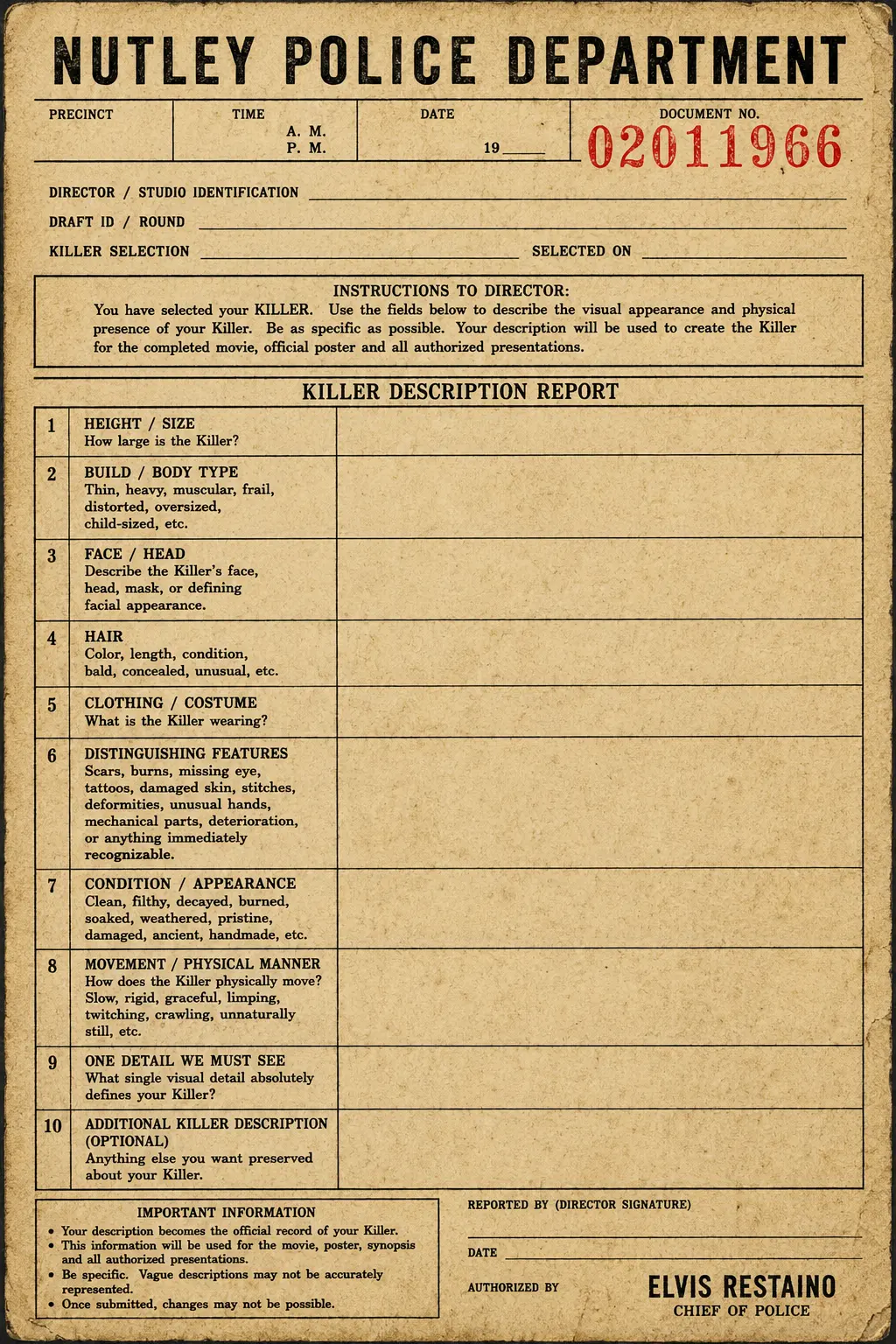
Choose the Killer that becomes the primary threat of your movie. You are choosing its core identity, not its final appearance: your other selections will shape how it ultimately fits your film. With a Director’s Choice Joker, you will file a Killer Description Report during Final Director Input, once you know your complete movie.
Main Role
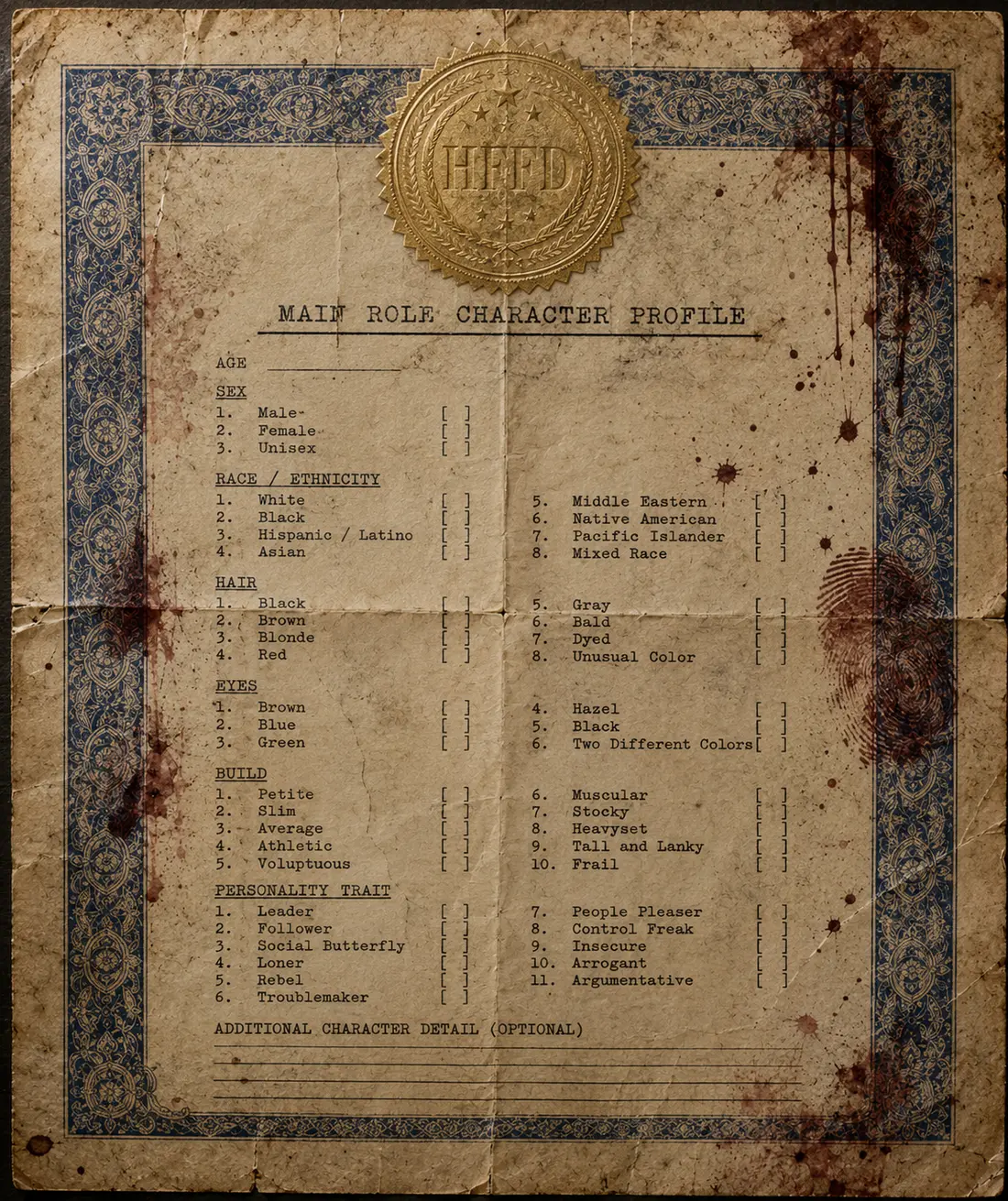
Choose the Main Role, the central character whose story you are building: the person the audience follows, whose decisions and survival drive the movie. The list is drawn fresh from a library that keeps growing over time. The archetype is only half of it. Once you have drafted it, you complete the Character Profile: age, sex, race or ethnicity, hair, eyes, build, personality trait, and one more detail if you want one. Archetype plus profile is your authoritative central character. If your movie receives a Feature Presentation, the generated Sidekick must have a believable connection to this completed character.
Opening Victim
Choose the Opening Victim, the character whose fate introduces the audience to the danger. Opening Victim does not automatically mean death: unless your choice sets a condition, they may die, survive, disappear, or be found after an attack. You are choosing a relationship, an identity, a discovery or a survival condition, and every one of the twelve choices is on the board when the draft begins. After the reveals you may add detail to the one you drafted. You can develop it, never replace it.
The two documents you fill in
Two of your selections open a document. Read both now, while nothing is at stake, so that none of it is new to you with a clock running.
 Open it full size
Main Role Character Profile
Your Main Role is the central character in your movie. Complete this profile by selecting one choice in each category and entering the character’s Age. Additional Character Detail is optional. Once submitted, these choices become part of your Main Role and cannot be changed.
 Open it full size
Director’s Choice Wild Joker
If you purchased the Director’s Choice Wild Joker, you will complete the Killer Description Report after your movie is drafted. Use the report to define the visual appearance and physical presence of the Killer you selected. Your description cannot change your drafted Killer. Once submitted, your description becomes part of the official Killer used in your completed movie and Feature Presentation.
From the final pick to the Feature Presentation
Once all Directors have completed their 16 selections, the drafting portion is over and nothing can be changed. The final sequence then runs in order.
- 1
The draft ends
Every selection is locked. No Director returns to the board. Every Budget is already known: it was revealed the moment its Director selected it.
- 2
Final Director Input
One shared countdown of 3 minutes. Every Director may add detail to the Opening Victim they drafted, and Director’s Choice holders describe their Killer. Both fields are optional.
- 3
The Killers take shape
Each drafted Killer is revealed as a full incarnation, built from the whole movie, and from your description when you wrote one.
- 4
The Feature Presentation winner is drawn
Only after every input is locked does the spotlight land on one of the Directors, at random. Until this moment, nobody knows whose movie will be selected.
- 5
Film Title holders name their movie
A window of 2 minutes for the Directors whose movie is being made and who hold a Film Title Joker. The title you submit goes to the writing itself, before a single word exists, so the synopsis is written for it rather than renamed afterwards. Nothing to do here if you do not hold the card, or if your movie is not one of the ones being made.
Final Director Input
Every Director may develop the Opening Victim they already drafted. That selection is permanent, and this is not a chance to swap it. If you drafted Father, you might make him an estranged father who has not spoken to your Main Role in fifteen years. If you drafted Best Friend, you might establish the falling out. If you drafted Stranger with a Secret Connection, you may define the hidden connection. You are adding character and history, not writing the opening scene: your Killer, Weapon and every other choice stay exactly as drafted.
This field is optional. If your drafted selection already says everything you want it to say, leave it empty: your Opening Victim stays exactly what you drafted, and the completed movie develops only what you left open.
Submit as soon as you are satisfied; you do not have to use the whole countdown. When time expires, the inputs close. An empty Opening Victim field changes nothing. A missing Killer description is simply lost for that draft, and your card returns to your hand.
Feature Presentation
Whether or not your movie wins the draw, your completed draft remains your movie. Your selections and Final Director Input stay attached to it, and an eligible completed movie can later receive its own Feature Presentation through a Feature Presentation Joker. Until then, its Sidekick stays the function you drafted: the character is only created when the movie is made.
The Joker Cards
Optional purchased advantages that give a Director extra control or access outside the normal 16-Tier draft. They never replace a Tier selection, and never occupy one of your 16 positions.
Front of the Line
Guarantees you one of the ten Director spots in the next available draft. It secures your place, not your position: once the room is full, the draft order is drawn through the same random process as everyone else.
Director’s Choice
Activated before the draft begins. You still draft your Killer normally; after the reveals, the Final Director Input window gives you the Killer Description field. Skip it or run out of time, and the opportunity is lost for that draft, but the card returns to your hand: it is only spent when a description locks.
Film Title
Lets you name your own completed horror movie instead of leaving the title to HFFD. Buying it does not switch it on: it wakes only if your movie is drawn for the Feature Presentation, or if you give your movie one with a Feature Presentation Joker. When it wakes, a window opens before the movie is written, your title goes to the generator rather than being pasted on afterwards, and the card is spent the moment you submit. A window that closes with nothing written returns the card to your hand.

Great Artists Steal
What a finished movie looks like
This is a real generation, not a mockup: the same roster, the same functions that run on the night. It shows what the sixteen tiers become once the draft is over.
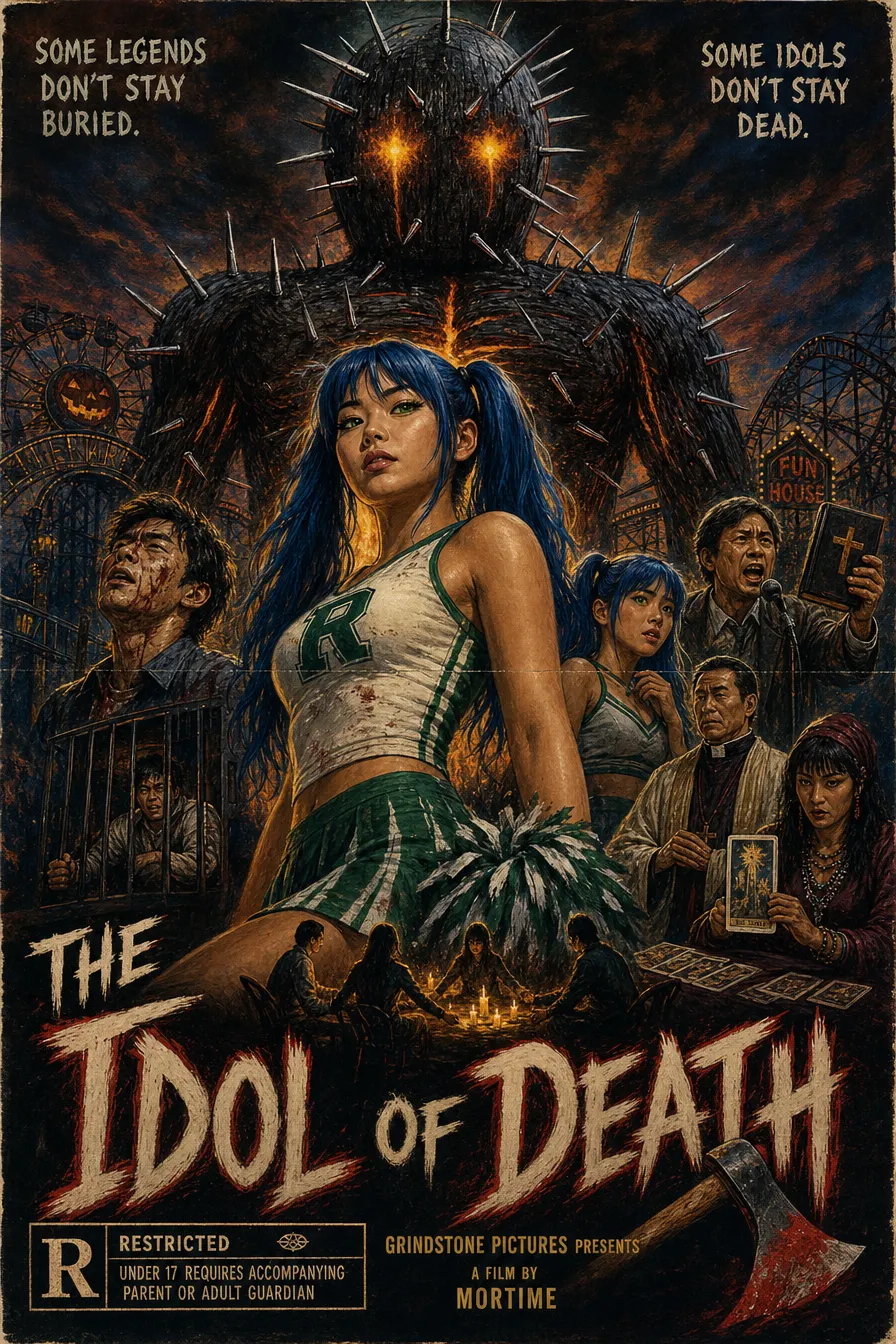
The Idol of Death
Grindstone Pictures
When her brother is impaled on a carnival gate the night an abandoned amusement park reopens for Halloween, the cheerleader captain must confront the fire-eyed idol of blackened wood and silver spikes a séance wakes. A raving street preacher's warnings go unheeded, a tarot reader uncovers the ritual's true price, and a parish priest guards the idol's secret. Wielding a fire axe, she fights to survive—until her twin sister pays the idol's blood debt herself.
Read the detailed synopsis
1384 words, written from the sixteen drafted tiers
Halloween night, 1978, somewhere off a coastal highway in California, where a shuttered amusement park called Marrow Cove has stood dark for eleven years.
The gates open again for one night only, strung with orange bulbs and a banner that reads REOPENING, and a stream of teenagers in costume pours through them like the park has been waiting.
Danny Chao goes first, laughing, daring his twin sisters to catch him on the old carousel path. He climbs the wrought-iron entrance arch for a photo, one hand hooked over a spike shaped like a screaming face, and the arch answers him. The gate's center spire drives up through his side before anyone understands what has happened, and he hangs there against the neon, mouth open, no sound coming out. Vivian Chao reaches him first. She is the one who holds his hand while the light in his eyes goes out, the one the crowd remembers screaming his name into a night that swallows it whole.
Voting on the finished films
Every finished film lands in the Horror Film Archive with its poster and its synopsis, and the audience scores it on five categories: originality, main role, killer, story and poster. The average of every submitted Voting Card is the film's official score, and that score sets its place in the rankings.
16 Tiers. 10 Directors. 10 completely different horror movies.